
My AI-Led Process for Demand Gen Content Planning

Most B2B content is garbage.
They’re guesses at the buyers’ needs. They underestimate resources. And are
1. mega-boring,
2. cringe
or both.
It’s part of the “random acts of marketing” - a non-strategy that many small marketing teams end up pursuing. What comes out on the other end of this (non-) approach is content that never gets created or what gets created dies a slow death on webpages with minimal traffic.
How to align content with GTM and the buyer journey
A real GTM plan is the foundation of a content motion that actually moves the needle.
It’s not just a list of activities, content and events. It must include:
Hard Data: Baseline metrics. What do we trust?
Buyer Journey Stages: Mapped in detail with clear entry and exit points.
Measurement: Leading and lagging indicators.
Buying Group: Who is involved? At what stage?
Information Gaps: Identify these in every buyer journey stage. What do they need to know to move down the path?
Objections: Also stage-by-stage. What hurdles will typically come up?
Core Beliefs: What ideas and beliefs, convictions must we plant, so that ?
Key Programs: The core marketing assets and campaigns.
Activities: The specific components.
Most GTM plans have a bit of 1 & 2, then jump straight to 8.
Disaster.
The meat of real demand generation is in 5, 6, and 7 and that’s what I want to focus on today.
The foundations of a great B2B content plan
Here is the process I use to build bulletproof content that builds pipe long and short term:
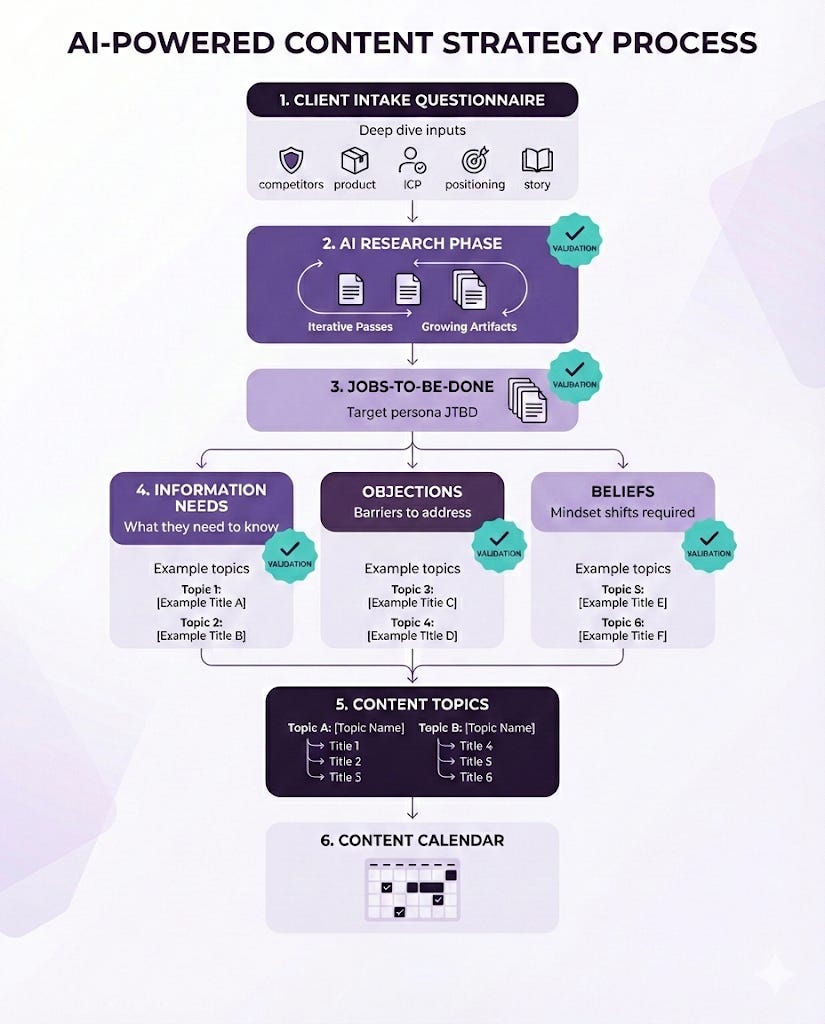
• Start with Jobs to be Done (JTBD). We send detailed questionnaires to clients. We research competitors, the market. We grill the founders. Take intel from sales calls.
100+ pages of context and knowledge are created for the steps following this.
• Use AI to fill the gaps. We use specific prompts to uncover information gaps for the decision-maker. What do they need to know to move to the next stage?
• Map Objections & Beliefs. We use AI deep research and prompt-chains to validate the hurdles and the beliefs we need to instil. And to validate the validation that AI uncovered.
• Human Validation. AI is smart, but I’m are smarter (lol) and so are you. Thus, we verify everything.
I’ll actually do a live demo where I walk through how we do all this with Claude Cowork:

Find content pillars that move buyers
Once you have this, we again use a series of prompts to
come up with content pillars for each stage
and pressure-test/validate them
Now we have content pillars (or main topics) for each buyer journey stage. At this point, we can technically get AI to brainstorm topics for each pillar.
Nail the pillars first. Prioritize them in order of importance. The format (video, blog, LinkedIn) comes second because much of the content will be repurposed into different formats anyway.
Priorities matter. As I’ve learned the obvious the hard way: we don’t have infinite resources. So the “parental warning” is:
You need to know your priorities. Content needs to not only be created, but also distributed. Both cost money, time and focus, so it’s wise to prioritize. Knowing your buyer journey gaps (a prerequisite for effective content planning) you can prioritize which buyer journey stages you want to focus on - and to what extent - in the coming 60-90 days.
We can’t do everything but we will find a way to do everything that matters.
Put other mandatory and optional elements into your content plan
This is specifically GTM content that will end up in your content-creation workflow. It doesn’t include a few types of content you might need to create, such as product marketing, customer marketing and:
If SEO or AI-SEO (GEO, AEO, whatever) is a priority, you’ll have specific topics/keywords you’ll want to focus on. These will - ideally - heavily overlap with the topics that the above-process spat out.
I like to leave some room in resources for random, urgent topics. Newsjacking is a great attention-grabbing tactic: if you can latch your message/story on to a hot news or current events, it works great to get attention and engagement.
The same goes for new events in your market - so if a cool new LLM model comes out and it’s relevant, and you just have to publish/talk about it - leave room or flexibility in the plan for those types of short-lived-asset-but-should-do-it-for-easy-attention.
Then you’ll have “ooh we need content about X for target account Y” which, if you’re doing ABM, is an entire category inside your content plan: pitch decks, research, articles, content co-created with the target account… the list goes on.
Note, that good GTM people don’t stop at buyer enablement content; they go on to align with customer success or delivery teams to create content that
- helps buyers remain buyers and preferably
- buy more and expand.
That means you may want to add one or two cycles in step 4: “what they need to onboard and adapt” and “expand”.
That’s how you build demand gen assets for a pipeline that flows.
Now, go and awesomize your content - blow buyers away!
Dan Renyi
- The Electric B2B Show
Ps.: If setting up planning content and building a workflow like this feels like too much work, I can help you in two ways:
1. do a 15 minute lightning call with you (free) and answer questions
2. do a 30 min call showing you how my team would build this specifically for you (also for free).
DM me or reply if either of the above 2 options look “interesting”.