

“We do a bunch of content, but not much happens.”
Guys, if I had a dollar for every time I heard a founder/GTM leader say this, I wouldn’t need to do content anymore. I’d just buy an island.
It’s a bloody frustrating place to be. You’re putting in the work. Content cal full in Asana, process grinding, Slack notif’s pinging. You’re shipping blogs, newsletters, and LinkedIn posts. Team reshares your work.
But when you look at the i.m.p.a.c.t.? Crickets. The brand feels flat. The “needle” isn’t moving or if it is, nobody thinks content has a lot to do with it.
“Just do more …and new!”
Most people look at this situation and think, ”We need to try a new channel” or ”We need to post more often.” They sprint toward a new tactic.
But tactics won’t fix a broken system. If your content isn’t working, it means there’s a leak somewhere in your engine.
Over the last few years, we’ve audited dozens of B2B content programs. We found that the ones that fail always break down in one of seven specific areas. And the order in which you fix them matters immensely.
If you fix step 6 but step 1 is broken, you’re just distributing noise.
Here is the 7-step diagnostic.
Where is your leak?
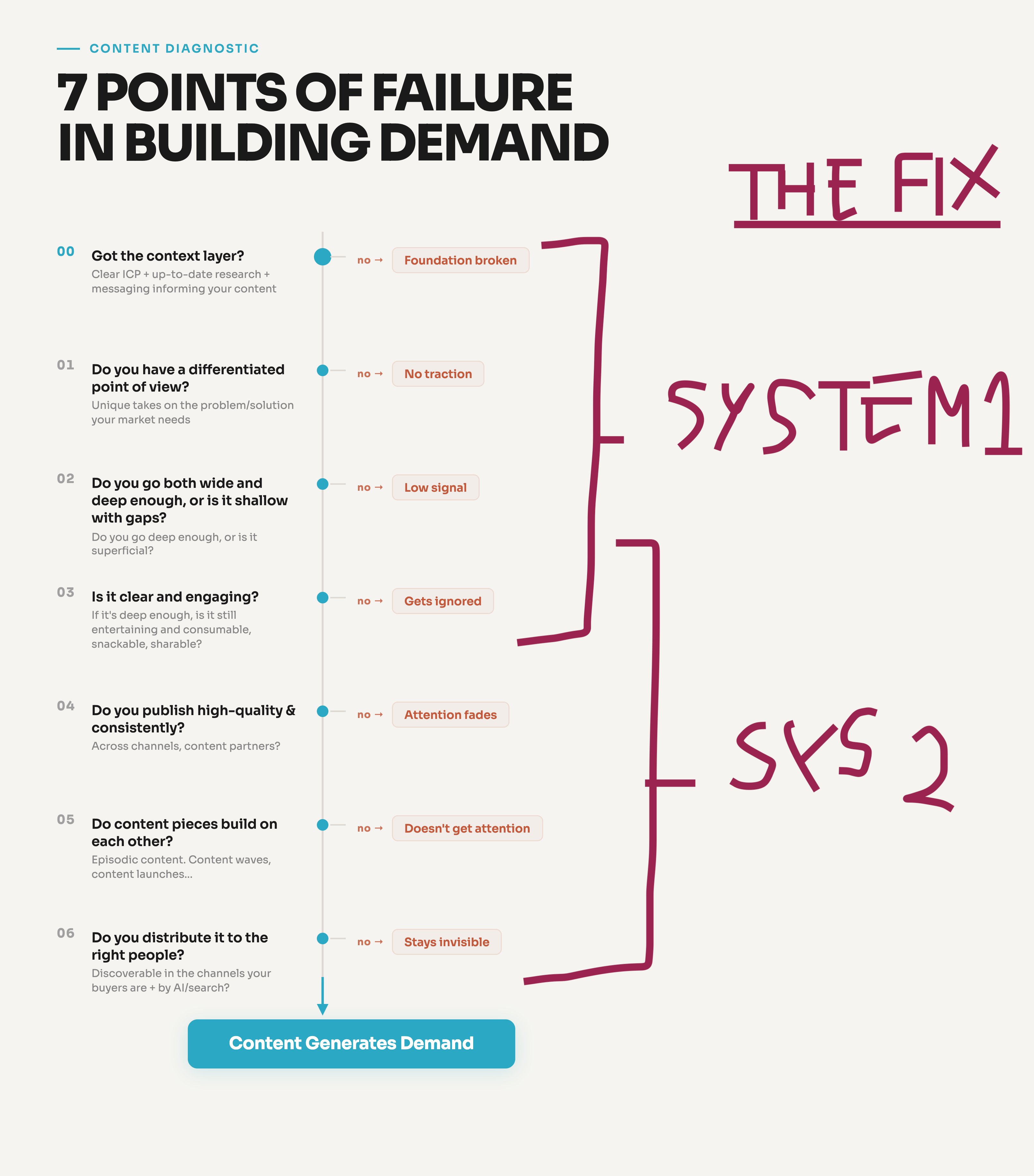
The components and systems 1&2 explained 👇🏻
0. Fundamentals
You can’t build a house on quicksand. Who exactly are you writing for? What is the bleeding-neck problem you are solving for them? What is your core positioning? If these answers are blurry, your content will be blurry.
Today, blurry content = content forgotten faster than you can say “thought leadership”.
When you try to speak to everyone, you speak to no one.
This context/research layer - now living in a repository and used by AI agents - constantly learns, researches and updates the workflows.
1. Narrative & Point-of-View
Are you leading a conversation, or just echoing what everyone else is saying? Your POV is your ultimate moat. “How-to” guides get commoditized.
A distinct narrative - a strong belief about where your industry is getting it wrong and how to get it right - cannot be copied. Without a POV, you’re just another vendor. With one, you become a thought leader.
2. Depth and Consumability
Are you going deep enough to actually change a reader’s mind? Surface-level fluff is ignored. But depth alone isn’t enough - it has to be consumable. High signal, low friction.
Can your buyer absorb your deepest insights while drinking their morning coffee?
If it reads like an academic paper, you’ve lost them.
3. Clarity and Engaging
B2B does should not stand for Boring-to-Boring. If your writing is dense, corporate, or full of jargon, people will click away. You need sharp hooks. Write like you speak. You need to respect the reader’s time by getting to the point. All the while keeping ‘em engaged with rhythm and pacing.
Expanding on the morning coffee example from Component 2:
Will your writing make them choke on their coffee, drop everything, and sprint to their keyboard to act?

It’s not just about insights (value) but delivery, style, connection.
4. Quality and Consistency
You can’t just be brilliant once a quarter. You have to show up consistently with high quality. Consistency builds trust; quality earns attention. Most teams sacrifice one for the other—they either post garbage every day, or a masterpiece once a year. The winners find a way to do both.
5. Content Stacking
Most of content is isolated, one-off pieces. What a waste. Content can act like chapters in a book, teasers for a movie, awesome fireworks that draw people in and disappear...
Example:
Piece A introduces the problem and leaves a curiosity hook - teases Piece B.
B unpacks the solution but sets a few honey traps. “Can’t wait for Asset C to drop!”
Asset C builds anticipation further with a couple case studies… a self-assessment…
Piece D drives it home. It’s the solution to the problem. Piece D can be an event, a big report, even a product/feature launch that provides a solution to the itch you introduced throughout.
Each piece earns the next. When content stacks, attention compounds. Without it, the AI-slop-noise buries your valuable content.
Oh, and in case it isn’t clear - you don’t need attention for attention’s sake. You’re not an influencer. The buyer’s attention is a MUST, a non-negotiable if you want her to buy.
6. Distribution
Publishing is not distribution. Hitting “post” is the starting line, not the finish line. If you don’t have a system to amplify your work—creating the Swell before it drops, the Break when it launches, and the Wash in the months after—your best work will die in silence.
The hard truth and the good news
Looking at that list, you might be thinking: ”Great. Now I ‘only’ have to fix seven extremely difficult things. Thanks, Dan.”
It feels overwhelming. It feels like you need a team of ten people to get it right.
But fear not. You really can do this. You can build a content engine that drives real revenue, and you don’t need a massive team to do it.
My advisory firm, Klear has approximately 0.39 content marketers. That’s actually me, in our small company, spending 15 hours a week on average on content-related stuff.
And we freakin’ check all these 7 boxes. I want to massively improve in a few components, but hey, it’s never finished, is it?
The secret isn’t working harder, but having a self-learning, smarter system.
We’ve built a system that takes human ingenuity; your unique POV, your expertise, your taste… and makes it work consistently and at scale by pairing it with AI.
It has two parts:
System 1: The ‘Content Product’ Layer.
In my house, content is a product, as I’ve explained earlier. It’s the
self-learning
auto-researching
self-updating
context-research-production layer. Gemini and Claude agents and workflows. AI is only as good as the context you give it. We’ve built a layer that captures your fundamental truths, your narrative, and your specific tone, and creates things. The system also stops the AI from doing dumbshit things and turns it into an extension of your best subject-matter expertise and thinking.
System 2: The Content Direction Layer: The Content Wave.
This is the attention-orchestration component. This system takes the raw materials from System One and structures them into stacked, consumable assets ready for distribution. It plans the Swell, the Break, and the Wash, ensuring your content actually reaches the people who need it.
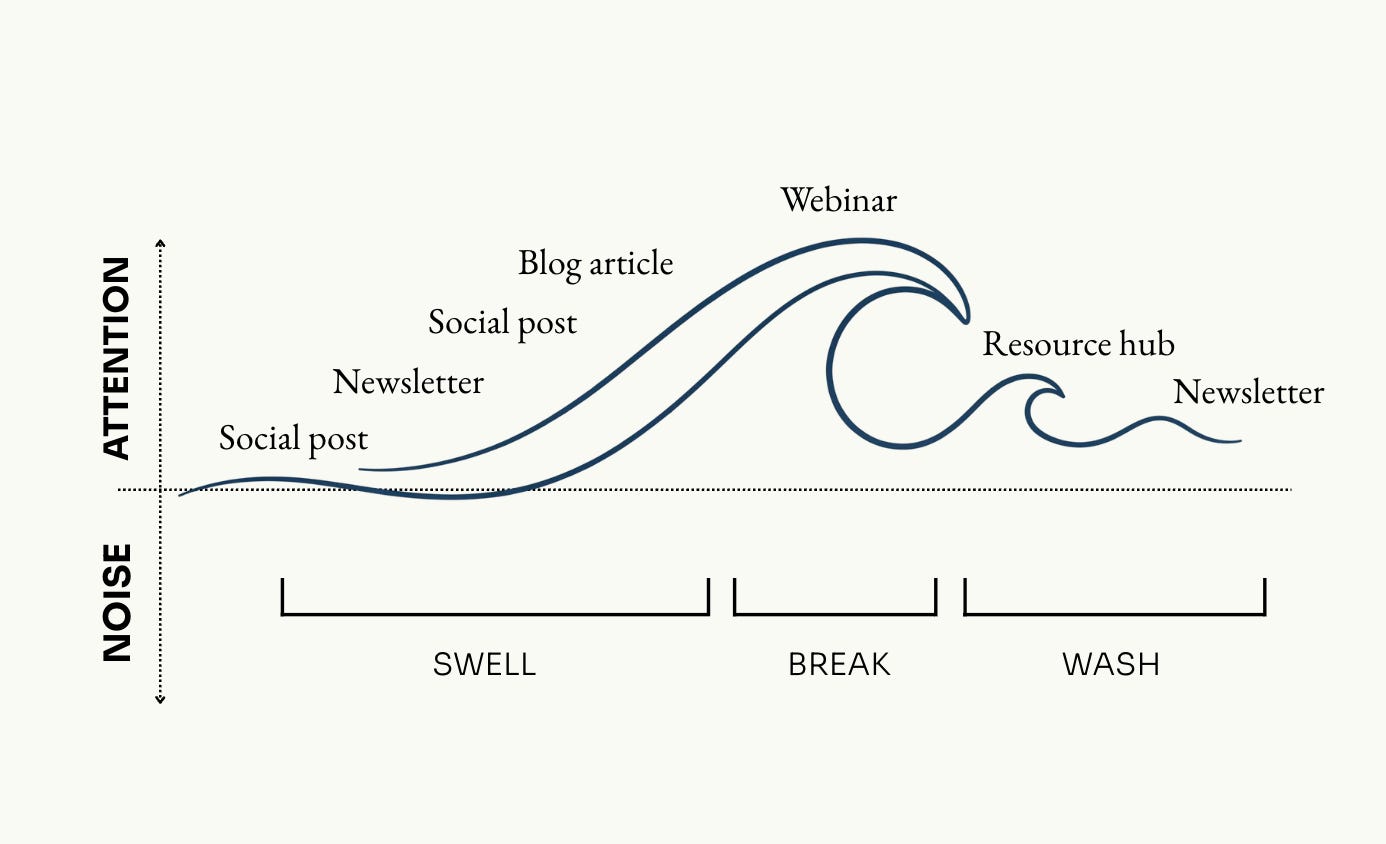
When you put these two systems together, content stops being a linear assembly line that nobody really enjoys and turns into a predictable, compounding asset - a PRODUCT for the business.
Now for the good great news: next Tuesday,
we’re showing you exactly how to build the two systems
We’re hosting a live workshop where we will pull back the curtain on this exact 2-part system. We’ll show you how to plug your own expertise into the context layer, and how to use the direction layer to orchestrate your next Content Wave.
You’ll walk away knowing exactly how to fix the leaks in your 7 areas, without burning yourself out.
Spots are limited because we want to keep it interactive. Get in on this:

Stop settling for content where “not much happens.” It’s not fun and certainly is not profitable. Build a system that is both.
See you Tuesday?
Dan Renyi


